
Abstract
This paper analyzes connection among human relations climate, perceived organizational support and employee readiness to change mediated by participative leadership. The model is based on systems theory and social exchange theory and it perceives organizational factors as interrelated system wherein any alteration in one aspect will affect whole system. Relying on idea of systems thinking developed by Peter Senge, study brings up role of trust, communication and cooperation in human relations climate as they affect perception of organizational support among employees and eventually their readiness to welcome change. Participative leadership supports such relationships by encouraging employee participation in decision-making process and underlining two-way feedback between the employees and organization. Also, integrating design thinking would bring with it a human, empathetic and iterative problem-solving strategy towards organizational change. This study provides effective suggestions to organizations willing to promote enabling environments, participatory leadership, innovation and flexibility to support sustainable and efficient change.
Keywords
Participatory Leadership, Human Relations Climate, Perceived Organizational Support, Readiness to Change, Social Exchange Theory, System Thinking
Introduction
Human relations climate is the climate of an organization that is influenced by human relations, communication and the general climate in an organization. One of the first scholars to come up with the concept of human relations climate was Schneider (1975), who stressed the use of interpersonal interactions in deciding how successful an organization is. Human relations climate depicts the way the employees think of the quality of relationships they have at the workplace and the overall mood that dominates their social interaction. Trust, cooperation, and good communication are encouraged in a favorable environment, and they consequently boost the morale and satisfaction of the workers. Such climate influences employee attitudes in a major way including job satisfaction, organizational commitment and willingness to participate in change initiatives (Schneider, 1975).>This has been further fostered more recent research which indicated that human relations climate affects organizational outcomes such as employee performance, retention and well-being (Saks, 2006). Also, a good human relations climate has been observed to minimize the resistance to change in the organization by fostering cooperation and flexibility (Choi, 2011). In particular, employees that feel significant and empathized by their colleagues and supervisors may accept organizational changes and avoid them as opposed to ignoring them (Klein and Sorra, 1996). Therefore, positive human relations climate may be the driver of change because it creates the climate of trust, respect, and open communication that is critical during the process of organizational transition.> Perceived Organizational Support (POS) is the level of the employee perception that his or her organization respects his or her effort and is interested in his or her well-being. Eisenberger et al. (1986) pioneered the concept by submitting that POS is one of the key elements in the formation of employee attitudes and behaviors. When employees feel that their organization is very supportive, they have stronger organizational commitment, better job satisfaction and perform better (Rhoades and Eisenberger, 2002). In addition, readiness of employees to change depends on POS. Employees who feel that the organization supports them are expected to have a positive response to organizational changes and perceive organizational changes as opportunity, as opposed to a threat (Rhoades et al., 2001).> It has been confirmed that the POS increases the psychological wellness of the employees by alleviating job stress and job insecurity, particularly during transitional times in an organization. POS also fosters an organizational culture of support and fairness, which promotes employee engagement and reduces turnover intentions (Stinglhamber et al., 2011). Additionally, POS has been found to mediate the relationship between organizational climate and employees’ attitudes toward change. Specifically, when employees perceive their organization as supportive, they are more likely to develop a positive attitude toward change, resulting in increased readiness for change (Baran et al., 2012). Therefore, POS is essential for fostering a change-friendly environment, where employees feel secure and motivated to adapt to new organizational demands (Shamas, et al.,2025).>Readiness to change refers to the cognitive and emotional preparedness of employees to accept and engage with organizational change. It was first coined by Armenakis et al. (1993) who understood the term as the level at which the workers feel that change is warranted, that it will be positive, and also that they can play a part in the same. The willingness to change is essential in achieving the success of any change initiative since employees willing to change tend to engage in the process more and are unlikely to fight the change process (Armenakis et al., 1993). Research over time has expanded on this backing notion by establishing numerous antecedents of readiness to change that include leadership style, organizational climate, and POS (Weiner, 2009). Leaders who develop a culture of trust and open communication have higher chances of increasing the willingness of the employees to change (Vakola & Nikolaou, 2005). Moreover, it has been noted that POS has a positive impact on readiness to change since employees whose organizational support is strong have a higher chance of positively perceiving changes (Zhao et al., 2018). On the other hand, the resistance to change may occur when the employees feel not secure or unsupported in the processes of change (Oreg, 2006). This means that not only the attitudes of the individual determine the readiness to change but also the organizational context under which the change takes place. Moreover, participatory leadership may also contribute positively to the willingness to change since it entails the engagement of the employees in the change process and makes the latter feel empowered (Zhu et al., 2012).> Participatory leadership is a leadership approach in which leaders engage employees in the decision-making process so that their contribution is factored in the procedures and planning in the organization. This concept was first examined by Vroom and Yetton (1973) in their model of decision-making that asserts that leadership efficiency is maximized in cases where the leaders involve the subordinates in making decisions. There are several positive consequences that are linked with participatory leadership among them being greater employee motivation, employee satisfaction and commitment to the organization (Jung and Avolio, 2000). Moreover, the leadership style promotes ownership and responsibility of workers that lead to increased engagement and performance (Seibert et al., 2011).>Participatory leadership is especially critical in the situation of organizational change. When leaders consult employees and consult with them when making decisions and implementing changes, they are less likely to face opposition to change and are more likely to have the new strategies implemented successfully (Zhu et al., 2012). The participatory leadership approach creates a culture of teamwork and mutual responsibility that increase chances of staff members feeling propped up in the face of change. In its turn, it can lead to increasing the willingness of the employees to change since it will make them feel that their suggestions are important and that they have a control over the change process (Zhao et al., 2018). Furthermore, the literature demonstrated that participatory leadership may mediate the connection between the organizational climate and readiness to change since it fosters trust and transparency which are necessary to diminish resistance to change (Zhao et al., 2018).>Kotter (1996) emphasized on the necessity of establishing a culture of change where the organization is in a continuous search of improvement, introduction, and adaptation. This has been consistent with the concept of systems thinking where change within organizations is considered to be coherent and holistic. When there is a change in one aspect of the organization, the other aspects of that organization are affected in some manner and this leads to the ripple effect which requires a well-organized endeavor. Systems thinking notes that effective organizational change is not a sequential process but a process of feedback loop of adaptation and realignment. Leadership plays a significant role in enabling this continuous process, especially in the way it determines the organizational climate and creates the feeling of being supported by the employees. Participatory leadership is a very critical component of this model since it promotes the participation of employees in the decision making and promotes cooperation.>It also minimizes the opposition to change and helps to build social relations within an organization. A social exchange theory grounded on work emerged as a result of the efforts by Blau (1964), who mentioned that the extent of adjustability to a change within the organization rested on the perception of the workers in regards to a just practice, support system, or reciprocity that was being offered by and through the organization. Employees would respond positively to any change and they would be more participative in the process when they feel that the organization is supportive and fair. Application of systems thinking and social exchange theory in organizational change study provides an all-round framework of comprehending dynamic relations among various aspects within an organization. Systems thinking focuses on interdependence of factors within the organization, in which a change in one aspect such as leadership or climate may significantly impact the rest of the system. Social exchange theory focuses on reciprocity of relations between the employee and the organization in explaining perceived organizational support and leadership behavior and their effects on employee readiness for change.> As service providers were able to keep responding to the increasing demand for faster and more reliable connectivity, there was a boost in the Pakistan IT industry, promoting innovation and new opportunities for telecom sector. Such factors' concentration underlines the prime role that telecommunication plays not only in connecting people but also in boosting the economy and making life more digitally connected. Of course, it has to be noted that the Pakistani government is working rapidly enough to streamline the process regarding entry of innovation G, 5G technology to the country.
Theoretical Frame Work And Hypotheis Development
Based on the working environment in Pakistan the dire t as wel as indirect relationship of human relation climate and Perceived organizations support was checked with readiness to change. The mediation of participatory leadership also has been checked in order to hypothesized the framework (Figure 1)
Figure 1
Research Model
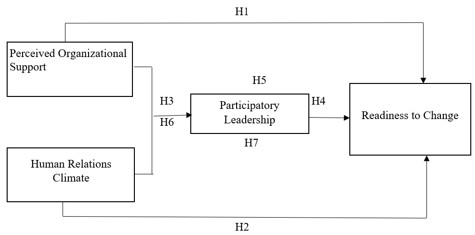
Readiness to Change with Perceived Organizational Support and Human Relation Climate
The previous studies have checked the impact of readiness to change and perceived organizational support in several industries. There is the positive effect of readiness to change and perceived organizational support. In one of the studies change commitment and efficacy exhibited variability across different nursing colleges, although overall perceptions remained positive. The results show a slightly high preparedness to a change introduction which presupposes the strategic support that goes beyond the resource distribution, qualifications of the staff, and positional power. It is important to note that the group dedication and trustworthiness of college members are vital factors that predict the readiness to change. Hence, establishing a sense of purpose and establishing trust between the staff members can contribute to the overall success of change initiatives in nursing education to a considerable degree. The situation was verified in nursing college where the readiness to change determinants have been verified (Alboroto et al., 2024). Posed organizational support (POS) is very instrumental in boosting individual change preparedness within organisations. As soon as employees understand that their organization appreciates them and is interested in their well-being, they tend to feel safer psychologically and trust their employer, which will eventually allow them to feel positive regarding change. Such favorable environment does not only motivate and involve the employees but also offers them necessary materials, including training and mentorship, which they can use to make the transitions successfully. Moreover, organizations that actively support can eliminate the fatigue of change, which will decrease resistance and promote proactive behaviors of employees. There is always empirical data that POS is positively correlated with individual change readiness, which implies that employees with high support perceptions are more likely to be involved and adjust to change initiatives. Thus, through support culture development, organizations are greatly able to increase employee change preparedness, which will culminate in a more successful change initiative implementation (Gigliotti et al., 2022)>H1: Perceived organizational support has a positive effect on readiness to change>Personal willingness to change is generally accepted as a significant element to organizations with strategic goals of attaining their strategic goals and instating change programs successfully. Although the significance of this preparedness is accepted, there is a lack of knowledge concerning the concrete climatic antecedents that may affect the readiness of employees to accept change. The study was carried out in order to investigate the links between different organizational climates with the personal willingness to change using bandwidth-fidelity theory as a framework. Bandwidth-fidelity theory suggests that the difference between broad and specific concepts could significantly individuals’ results, and therefore, it is mainly relevant to this study. It focuses specifically on two dimensions of executive climate: a grinder human relations climate, which encompasses the overall quality of social relationships and support within the organization, and a side-specific learning climate, which emphasizes specific aspects of learning and development opportunities available to employees. Although speculative about how these distinct yet cohesive climates relate to particular preparation for change, this learning seeks to enhance the understanding of how structural contexts may help or hinder workers' preparation for change. Ultimately, the solutions may provide useful insights for structural leaders and change practitioners who aim to design environments that better facilitate worker involvement and flexibility during times of change (Motland et al., 2018).>H2: Human relations climate has a positive effect on readiness to change
Relating perceived organizational support and human relations climate with participatory leadership
The term participatory leadership refers to one type of leadership style. It involves making leaders and employees both participate in the organization’s work. It is a collaborative style of leadership where the focus is on the active involvement of team members in the decision-making process (Banjarnahor et al., 2018). This approach fosters an open communication and shared responsibility setting, where everyone, from top to bottom of the hierarchy, can contribute input. Participatory leaders often work with their team members to engage them in teamwork and cooperative problem-solving, fostering a sense of initiative and ownership in the employees regarding their tasks.>By this means, such leaderscreate an environment in which membersofthe team are liberty to air out their views without judgment of their thoughts or opinions. (Helmi Buyung et al., 2020). In previous studies various styles of leadership has been determined. Their antecedents and outcomes have been declared with the support of rigid systematic review on the variable. The previous study checks the firm leadership style and behavior and access that both are particular to each other in nature. The systematic review on leadership on family firms has been checked by considering more than 95 research articles in 25 different peer- reviewed journals. The different generic leadership styles were investigated which also contains participatory style, it was originated from the general literature on leadership. A framework was developed specific antecedents and outcomes of leadership style and behavior in family firms. The role of participation considered to be fruitful and can play essential role for future avenue. A better understanding of firm’s family leadership style and behavior can affects alter the strategies and decision-making processes to encounter the firm’s family needs. This research generated the insights on leadership style and behaviors in family firms. The analysis was done by the mix of several antecedents of leadership style like participative, autocratic, transactional and transformational which leads to superior outcomes. The scales were also validated for family firm’s specific leadership behavior. According to the previous research the participative leaders are highlighted by their inclusive decision-making style which creates the employees reasoning due to which mutual agreements and values are shared among employees and leaders.(Fries et al., 2021) The solutions can be generated collectively. In one of the researches the leadership in participatory modeling has been checked and it was recognized that there is a need for it or not. The analysis was done. This concept led to the great picture which can set the right goals for the future success. Th role of leadership and its significance has been distracted which shows it is positively required for today’s management. Sensitivity to local dynamics, stakeholder’s engagement, ethical planning, bias awareness modeling and resource planning are the factors which can be settled with the support of leadership perspective. This paper suggested to consider the leadership perspective in development of the projects. In the analysis the categories of project management process were accessed with the suitable combination of leadership style and management. The comparison among leadership and management has been done. Several theories of leadership like spirula, shared leadership, distributed leadership, Laissez-faire leadership, system leadership and transformational leadership styles has been accessed in the paper. System thinking was investigated the core leadership discipline. The system is the basic part through which organizations go thorough in solving any problem. The system intelligence can be helpful for individual as well as organizational perspective. The paper suggested that there is the great need for the leadership style in order to get things done in a great manner. The human dimensions and integration of system is the challenge which cannot be only managed by improving technical management (Hämäläinen et al., 2020) . The relationship among leadership style and organizational innovation has been investigated in the previous study by reviewing 64 journals articles.it was checked that several leaderships styles have the positive impact on innovation of the organization both directly as well as indirectly. The article analyzed that by enhancing several leadership styles the factors such as organizational climate, Leader’s behavior or other variable like learning and knowledge sharing can be influenced within the organizations. The paper between 2000 and 2019 were investigated by considering the terms such as innovation and leadership (Alblooshi et al., 2020). The gender-based study was done in order to access females have more participatory style as compared to males. The data was collected from principals of urban schools. The results stated that the difference in leadership style is based on the specific activities and form of strategic planning done by the organizations (Sebastian & Moon, 2017). The critical review of leadership style in contemporary hospitality was done by the reviewing 79 articles on leadership style in the hospitality industry. It was stated that the leadership styles gain power in the past 13 years but there are some empirical and concept-based overlaps among several styles of leadership. It is important to know the antecedents and outcomes of the different leadership styles in the organizations as different culture, strategies and planning taking place in the organizations require different styles of leadership. The metanalysis review on participation, satisfaction and productivity was done in the past. There was the strong support between participative climate and worker satisfaction which can further leads to the accomplishment of goals. Several articles were searched in order to get the link among both the variables. investigating the differing impacts of participative climate and participation concerning specific issues on both satisfaction and productivity may provide valuable insights into the cognitive and emotional processes involved in participative environments.(Miller & Monge, 1986) . The variable of organizational resilience with shared leadership has been checked by systematic review. Out of 200 articles the 43 articles were investigated through exclusion criteria resulting. The results concluded that there is the urgent need for the shared leadership in today’s fast changing business environment. With the great revolution the process of system thinking with combination of shared value can be the best fir for the succession of the goals within the organization. Moreover, the research resulted that there is the lack of relationship among shared leadership and organizational resilience but it should be checked in future in order to evaluate the results. The shared leadership can lead to spurs exceptional outcomes which can further improve capabilities to solve the complex issues taking place within the organization.(Gichuhi, n.d.)>H3: Perceived organizational support has positive impact on Participatory leadership.>Employees who feel part of the decision-making circle tend to have higher job satisfaction and engagement and facilitate the organization in building better outcomes through various sources. Overall, participatory leadership promotes an environment at work that is creative and flexible in meeting demand as team members become concerned with the success of the organization as well. In the latest study, for instance, illegal and small-scale mining remains rampant in Ghana as the country lacks process-oriented leadership characterized by accountability, predictability, and socially just decision making in balancing the interests of the state and society. This perennial issue is proposed to be addressed by using the concept of social license to really help and empower active participation of local communities in governance and decision making. Community actors by encouraging grassroots efforts can be at the forefront in breaking the cycle of illegal mining which will ultimately result in improved livelihoods and more sustainable environments in mining-affected areas (Sefa-Nyarko,2024).>The FYIC experience puts emphasis on the need of the inclusive, trauma sensitive, and responsive leadership that takes into account their specific situation. The British Columbia government assistance is now provided up to age 27, however, individuals are still traumatized at the age bracket of 3045 years in a persistent and chronic basis which could result in more than the existing policies to cater to their ongoing needs.>From the view point of leadership, the study emphasizes FYIC'S active engagement with policymaking processes that affect them. Including FYIC in policymaking empowers them but at the same time allows policies to be designed based on the everyday reality that they face. In this direction, effective leadership means doing community-based participatory action research where FYIC voices concerns, shares experiences and gets involved in actions to decisions related to their future directions.>The role of such trauma-informed leadership continues because the leaders are supposed to be aware of psychological or emotional distresses which one needs to bear with for such a journey and take necessary steps for guidance. Leaders can improve the decision- making and risk management processes that benefit FYIC by promoting cultures of safety for psychological talks and discuss open access. Other important aspects of leadership involved here are congratulations of talent skills of FYIC. The congruent acknowledgment of their work can boost their self-esteem and belonging importance aspects in personal and professional development. The end is to design programs and activities that engage FYIC in making use of these strengths while enhancing their conditions so that they are better equipped with a sense of control. The last one is the necessity to create effective feedback mechanisms as responsive leadership. Development of mechanisms by which the FYIC offer feedback of policies and programs enable leaders to keep on changing and revising initiatives according to the demands of this population. It is an ongoing process that guarantees the suitability of the policies and reaction to emerging demands and the evolving objectives of FYIC. In conclusion of the above researches, the study focuses on trauma-informed practices, inclusive practices, institutionalization of FYIC, and feedback. With these principles in mind, leaders are able to come up with policies that can go a long way in transforming the lives of the former youth in care. Notably, these policies can resolve the underlying issues that these people face.>H4: Human Relation Climate has the positive impact on Participatory leadership.
Relating Participatory Leadership with Readiness to Change
With the ever-changing Pakistani workplace, the interplay between adaptive leadership and Safety Citizenship behaviors is quite very critical since the threat to the safety posed is increasingly more with the work places. The connection between readiness to change and participatory leadership has been verified in earlier studies.>This paper examines how adaptive leadership can be used to enhance safety citizenship behaviour as part of the informal job activities in order to make the workplace a safer place. Three factors are identified according to the research: the readiness to change, psychosocial safety climate, and proactive personality. Readiness to change can be described as the willingness of the employees to participate in the change initiatives in the organization. This goodwill can be reinforced by adaptive leadership to maximize the chances of employees engaging themselves in safety activities. The other positive psychosocial safety climate can be attributed as a sign of collective thinking among employees that their psychological health is considered so that it is probable that individuals will engage in safety efforts. The proactive personality which is an individual tendency to act should also be a factor since such persons tend to recognize the hazards and recommend changes. Altogether, this paper highlights the significant role of developing adaptive leadership skills that help to realize a safe and responsive work environment and underline the necessity of developing a leader that will be able to accommodate change and focus on the welfare of the employees. Previously the aim of the research was to explore how change leadership impacts on the willingness of employees to change in the selected public organizations in the Amhara National Regional state of Ethiopia. The researchers conducted a population of 2,546 workers who were sampled out of eight government organizations that had embarked on different change programs. A simple random method of sampling was used to select a sample of 514 employees, who were used to conduct the research in order to fulfill the objectives of the research. Both, exploratory and confirmatory factor analysis, were used to determine the reliability and validity of the measurement instruments that were used in the study. Data analysis was then carried out and the proposed hypotheses were tested with structural equation modeling. The results showed that there are strong ties between change leadership and organizational culture and organizational culture and employee readiness to change. However, the findings revealed that change leadership made no direct effect to change readiness of employees and that organizational culture had no mediating role between change leadership and change readiness of employees. In conclusion, the research paper presents some useful knowledge to the current body of research and provides a ground to be used in future research activities in the field (Engida et al., 2022).>H5: Participatory leadership has a positive effect on readiness to change.
Relating Participatory Leadership as A Mediator Between Human Relation Climate, Perceived Organizational Support Readiness to Change
Also, it was observed that the variations between both the original and modified fully mediated models were not significant to offer the correct fitting of the data, which further indicates that perceived organizational support mediates in the relationship between the human relations organizational climate and the readiness of the employees to the change. This elicits a significant aspect of evoking theoretical knowledge of organizational climate in the manner of the focus of change facilitation through perceived organizational support. The employees feel that the organization is establishing a favorable environment that has positive human relations (Spector., et al 1986)>They will be favorable to the spirit of embracing change in a practical sense, it is advisable that organizations adopt strategies that will help develop a positive human relations climate. These measures may involve the enhancement of open communication, acknowledgement of client employee contribution, and provision of sufficient resources and training to assist employees in transition. Organizations can greatly support the readiness of employees to change by promoting a climate in organizations that is characterized by support and positive human relations, which will result in greater implementation of change initiatives and better performance of organizations. The multifaceted nature of such a solution strengthens the abstract implications of the study but also provides practical information that practitioners can use to successfully overcome the challenges of organizational change (Myklebust et al., 2020).>It has been shown by the previous researchers that the links between instrumental climate, caring climate and independence climate are largely mediated through the perceived organizational support, which is an individual level variable. The instrumental and caring climates are more oriented on the performance goals and the achievement of tasks, and the caring climate is more aimed on the emotional well-being and support of the employees. Independence climate on the other hand, gives employees freedom to make decisions on their own, and operate independently in the organization (Eisenberger et al., 2002).>Acquiescent silence is the one in which employees may not say anything about undesirable circumstances because they are afraid of being reprimanded, and defensive silence is where employees do not say anything because they are afraid of being attacked (Morrison, 2011). The outcomes of the recent studies show that the employees are more secure and cherished when they realize that there is a lot of organic support in an organization. This perception has a major impact of decreasing the two kinds of silence (Morrison and Milliken, 2000). The results highlight the importance of having a conducive organizational culture that appreciates and acknowledges the input of employees (Rhoades and Eisenberger, 2002).>H6: Participatory leadership positively mediates the relationship among perceived organizational support and readiness to change.>To the management, it would imply forming environment where organizational support is properly articulated and perceived because such initiatives could minimize silence actions that may negatively affect organizational performance. The study also recommends that upcoming research ought to further investigate the effect of various variations of organizational support on various manifestations of silence and engagement of employees across different organizational setting (Wangombe et al., 2021).>Personal preparedness to change is well known as a key determinant of organizations that strive to fulfill their strategic goals and have change processes successfully accomplished. Although the significance of preparedness has been established sufficiently, the lack of knowledge concerning the exact climate-based antecedents that can affect the willingness of employees to accept change continues to exist. The aim of this research to discuss the correlation between different organizational climates and the readiness of individuals towards change based on the bandwidth-fidelity theory. According to the bandwidth-fidelity theory, the disparity between broad and specific concepts may considerably affect the outcome of individuals, hence, is primarily applicable in the current study. It is particularly concerned with two aspects of executive climate, namely a grinder human relations climate, which deals with the general quality of social relations and support in the organization, and a side specific learning climate, which deals with the specifics of learning and development opportunities open to employees. This learning is speculative in its approach to how these unique and consistent climates are connected with specific preparation to the change though this is done in the hope of increasing the knowledge on how the structural contexts can facilitate or inhibit workers preparation to change. Finally, the solutions can offer valuable lessons to structural leaders and change practitioners that want to create an environment that is more conducive to worker participation and flexibility when change takes place (Motland et al., 2018).>H7: Participatory leadership positively mediates the relationship among human relations climate and readiness to change.
Research Methodology
Sample and Procedure>This study applies a quantitative and cross-sectional research approach to investigate the relationships between human relations climate, perceived organizational support, and readiness for change, with emphasis on the mediating role of participatory leadership. This research design allows the collection of data at one point in time, which then gives an overview of factors that influence the willingness of employees to accept organizational changes in the telecommunications industry. A questionnaire was designed systematically, which was taken from earlier research. Thus, it ensures uniformity in the assessment of basic constructs. The quantitative method of analysis is suitable to investigate both the size and the direction of the relationships of the variables under investigation. The research design was based on the Research Onion model of Saunders (2009), which is a general depiction on the organization of the methodology of a research study. The study was based on the positivist philosophy that is common in quantitative research. This study used deductive method that is, the researcher tested the available theories by gathering and examining the empirical data. The literature of organizational behavior and leadership given the influence of human relation climate and organizational support on readiness to change was utilized when deriving the hypotheses. The study adopted a survey methodology in gathering information. The relationships among key variables were measured by the use of a structured questionnaire given to employees working in telecom industry in Rawalpindi and Islamabad A quantitative methods- The selection of a quantitative methodology was supported by the fact that the research sought to assess the relationship between key variables. This is appropriate in analyzing big data and determining the statistically significant trends.>A cross-sectional time horizon was used, meaning the data were collected at a single point in time. This approach was appropriate for the study, as it aimed to examine the current relationships between the variables of interest without considering changes over an extended period. The study employed probability sampling, with a purposive sampling technique.> >Sample>In conclusion, G*Power analysis suggested that the sample size should be 68, but a sample size of 157 in this study significantly enhances the statistical power and reliability of the study. The data was collected from the employees of telecom industry who are working as aa supervisor and leaders.>Measures>In the questionnaire items included were: Human relations climate (Independent Variable), Perceived organizational support (Independent Variable), participatory leadership (Mediator) and readiness to change (Dependent Variable). In this study all the items used five points Likert scale for the measurement which included 1 (Strongly Disagree),2 (Disagree),3 (Neutral), 4 (Agree) and 5 (Strongly Agree).> >Human Relations Climate>Human Relation Climate was measured through 5-point Likert scale which has 8 items proposed by (Maribeth Kuenzi, 2008) one of them is, “Employees in my organization develop supportive, positive working relationships among organization members”. (? = .84). > >Perceived Organizational Support>Perceived Organizational Support consist of 8 items. Study used 8 items scale by (Eisenberger et al., 1997) in the research. One of the items of the construct is, “My Organization strongly considers my goals and values” (Cronbach’s ? = .90)> >Participatory Leadership>Participatory Leadership consist of 4 items one of them is, “Leader of Organization encourages working group members to submit ideas.” The scale used was developed by (Arnold et. al., 2000) (Cronbach's ? = 0.75)> >Readiness to Change>Readiness to Change consist of 5 items one of them is, “Change encourages me to make more efforts in my work.” The scale used in the research was developed by (Bouckenooghe et. Al., 2000). (Cronbach's ? = 0.93).
Results
Descriptive Statistics of Variables>The descriptive statistics for the four key variables Human Relations Climate, Perceived Organizational Support, Participatory Leadership, and Readiness to Change were calculated for a iuy6543eed34sample of 157 respondents. The findings disclose that the respondents moderately felt positive about all the factors in general. Human relation climate scored 3.39 (SD = 0.58) which is a slightly positive but mixed view of the organizational climate with a response that ranged between very low and very high (1 to 5). Similarly, the mean of the Perceived Organizational Support variable was 3.42 (SD = 0.58) which indicates that the employees are moderately supported by their organization, but the variance in the responses was observed. The mean of Participatory Leadership was 3.43 (SD = 0.62), which shows that one has slightly more than moderate perception of leadership practices, and the range of responses (1.75 to 5) demonstrates that the perception of leadership is highly varied. Lastly, the mean score of Readiness to Change was the highest at 3.64 (SD = 0.73) and thus it can be concluded that respondents generally think that their organization is ready to go through change, although there seemed to be a variable response again indicating that there are a variety of opinions about whether an organization is prepared to undergo change. These results imply that even though respondent opinions on the climate of their organization, support, leadership and change readiness are mostly favorable, there is a significant individual variability.> width="100%">
Variables
>N
>Minimum
>Maximum
>Mean
>Std. Deviation
Human Relations Climate
>157
>1
>5
>3.3901
>0.57776
Perceived Organizational Support
>157
>1.25
>5
>3.4212
>0.58361
Participatory Leadership
>157
>1.75
>5
>3.4283
>0.62343
Readiness to Change
>157
>1
>5
>3.6369
>0.72566
Valid N (listwise)
>157
> > > >>
>>
Mean
>Std. Deviation
>Skewness
>width="11%">
Kurtosis
Statistic
>Statistic
>Statistic
>Std. Error
>Statistic
width="11%">Std. Error
Human Relations Climate
>3.3901
>0.5777
>-1.125
>0.194
>3.042
width="11%">0.385
Perceived Organizational Support
>3.4212
>0.5836
>-0.579
>0.194
>0.955
width="11%">0.385
Participatory Leadership
>3.4283
>0.6234
>-0.206
>0.194
>0.201
width="11%">0.385
Readiness to Change
>3.6369
>0.7256
>-0.653
>0.194
>0.562
width="11%">0.385
Valid N (listwise)
> > > > > width="11%">Human Relations Climate
>Perceived Organizational Support
>Participatory Leadership
>Readiness to Change
Human Relations Climate
>1
>.552**
>.519**
>.477**
0.000
>0.000
>0.000
157
>157
>157
>157
Perceived Organizational Support
>.552**
>1
>.554**
>.528**
0.000
> >0.000
>0.000
157
>157
>157
>157
Participatory Leadership
>.519**
>.554**
>1
>.546**
0.000
>0.000
> >0.000
157
>157
>157
>157
Readiness to Change
>.477**
>.528**
>.546**
>1
0.000
>0.000
>0.000
>157
>157
>157
>157
Discussion
Limitations>While this study provides precious insights into the relationship between perceived organizational support, human relations climate, participatory leadership, and readiness to change, several limitations must be noted. First, the cross-sectional design limits the ability to make causal inferences. While we hypothesized perceived organizational support and human relations climate influence readiness to change positively and that participative leadership serves as a mediator between these factors, a cross-sectional approach was only capturing a time snapshot. The study was carried out within the telecom sector in Pakistan, which could limit the generalizability of the findings. Generalizing the findings to other sectors or regions would increase the external validity and facilitate comparison between industries. Finally, although System Thinking was used to understand the interrelationships between the variables, further exploration of system dynamics such as feedback loops and nonlinear interactions could provide deeper insights into how different elements of the system interact over time.> >Future Recommendations>Based on the limitations and findings of this study, several recommendations for future research can be made. The interplay between the perceived organizational support, human relations climate, participatory leadership and readiness to change development should be followed by longitudinal studies. A follow-up study would allow studying the time dynamics and the causal interactions of the study variables. The following research ought to increase the sample to cover employees in other sectors, such as healthcare, education, and manufacturing, to be in a position to test generalizability of the results. The cross-industry comparisons can show whether they are special to the telecom industry or they can be extended to other industries. Third, the future research may consider the extension of the model by incorporating additional variables such as organizational commitment, self-efficacy on employee level, and perceived organizational justice to shed more light on the subject of experiences employees have lived and their attitudes towards change. And finally, the concept of System Thinking needs to be used again in order to explore the complexities of the organizational change. Future research may explore the role of feedback loops, delays, and causal loops in the organizations in making the employees willing to change (Senge, 1990). This lens into the dynamic nature of the system may create new revelations about the way the organizations are able to make more out of the change processes and make them more favorable.
Conclusion
This research reveals some very crucial insights in the role of perceived organizational support and human relations climate, participatory leadership, and readiness to change in the telecom industry in Pakistan. The results emphasize the significance of perceived organizational support and favorable human relations climate to create the organizational environment that would support organizational change. The more support is perceived by the employees at all levels of the organization, the more willing they become to pursue change initiatives (Eisenberger et al., 2021). Also, there is a favorable human relations climate, which is marked with mutual trust and respect, which provides a favorable environment that helps employees embrace and practice new practices (Kanter, 2020). Another factor identified in the study is that of mediating role of participatory leadership that facilitates the change process by involving employees in the decision-making process and providing them with a sense of ownership (Nembhard and Edmondson, 2006). The results go hand in hand with Social Exchange Theory where perceived support and trust give rise to positive organizational performance including greater willingness to change (Blau, 1964).>The theoretical model of System Thinking has provided quite a special outlook of the interrelations between parts of organizations, including leadership, support, and climate, as the components, as a part of the entire system. This method is provided by the interdependence of various aspects, which makes it evident that even the change in the component may have significant implications on the final result (Senge, 1990). As an organizational change is viewed through the prism of Systems Thinking, this paper conveys the notion that an individual should not perceive complex and dynamic interactions between variables as individual phenomena (Meadows, 2008). This paper has offered a holistic view of the variables that shape readiness to change and presented both theoretical input and practical suggestions to managers who would need to enhance the process of change in organizations.
References
-
Alblooshi, M., Shamsuzzaman, M., & Haridy, S. (2020). The relationship between leadership styles and organizational innovation: The mediating role of organizational learning. European Journal of Innovation Management, 23(4), 713–732. https://doi.org/10.1108/EJIM-11-2018-0256
-
Alboroto, R., Garza, T., & McNaughtan, J. (2024). Readiness for change: Understanding the importance of empowering leadership. Children and Youth Services Review, 163, 107768. https://doi.org/10.1016/j.childyouth.2024.107768
-
Armenakis, A. A., Harris, S. G., & Mossholder, K. W. (1993). Creating readiness for organizational change. Human Relations, 46(6), 681–703. https://doi.org/10.1177/001872679304600601
-
Avolio, B. J., Walumbwa, F. O., & Weber, T. J. (2004). Leadership: A review and future directions. The Leadership Quarterly, 15(6), 321-340. https://doi.org/10.1016/j.leaqua.2004.09.004
-
Banjarnahor, H., Hutabarat, Z., & Siburian, P. (2018). The effect of leadership, organizational climate, and organizational culture on employee performance. International Journal of Civil Engineering and Technology, 9(10), 123–134
-
Baran, B. E., Shanock, L. R., & Miller, L. R. (2012). Advancing organizational support theory into the twenty‑first century world of work. Journal of Business and Psychology, 27(2), 123–147. https://doi.org/10.1007/s10869-011-9236-3
-
Blau, P. M. (1964). Exchange and power in social life. Wiley. https://doi.org/10.4324/9780203792643
-
Choi, M. (2011). Employees’ attitudes toward organizational change: A literature review. Human Resource Management, 50(4), 479–500. https://doi.org/10.1002/hrm.20434
-
Eisenberger, R., Cummings, J., Armeli, S., & Lynch, P. D. (2001). Perceived organizational support, discretionary treatment, and job satisfaction: A longitudinal study. Journal of Applied Psychology, 86(5), 1020–1027. https://doi.org/10.1037/0021-9010.86.5.1020
-
Eisenberger, R., Huntington, R., Hutchison, S., & Sowa, D. (1986). Perceived organizational support. Journal of Applied Psychology, 71(3), 500-507. https://doi.org/10.1037/0021- 9010.71.3.500
-
Eisenberger, R., Stinglhamber, F., Vandenberghe, C., Sucharski, I. L., & Rhoades, L. (2021). Perceived organizational support: A review of the literature. Journal of Applied Psychology, 106(1), 39-60. https://doi.org/10.1037/apl0000465
-
Engida, T., Rao, D. P., & Abebe, M. (2022). Participatory leadership and employee performance: The mediating role of employee engagement. International Journal of Organizational Analysis. https://doi.org/10.1108/IJOA-03-2021-2691
-
Fries, A., Kammerlander, N., & Leitterstorf, M. (2021). Leadership Styles and Leadership Behaviors in Family Firms: A Systematic Literature Review. Journal of Family Business Strategy, 12(1). https://doi.org/10.1016/j.jfbs.2020.100374
-
Gigliotti, R., Vardaman, J., Marshall, D., & Gonzalez, K. (2022). The role of leadership in shaping employee readiness for change. Journal of Organizational Change Management, 35(2), 223–239. https://doi.org/10.1108/JOCM-04-2021-0127
-
Hämäläinen, R. P., Miliszewska, I., & Voinov, A. (2020). Leadership in participatory modelling – Is there a need for it? Environmental Modelling and Software, 133.
-
Helmi Buyung, H., Putra, A., & Sari, R. (2020). The influence of leadership style and organizational climate on employee performance. International Journal of Scientific & Technology Research, 9(3), 3375–3380. https://doi.org/10.1016/j.envsoft.2020.104834
-
Kanter, R. M. (2020). Confidence: How winning streaks and losing streaks begin and end. Crown Publishing.
-
Klein, K. J., & Sorra, J. S. (1996). The challenge of implementation. Academy of Management Review, 21(4), 1055–1080. https://doi.org/10.5465/amr.1996.9704071863
-
Kotter, J. P. (1996). Leading change. Harvard Business School Press.
-
Meadows, D. H. (2008). Thinking in systems: A primer. Chelsea Green Publishing.
-
Miller, K. I., & Monge, P. R. (1986). Participation, satisfaction, and productivity: A meta‑analytic review. Academy of Management Journal, 29(4), 727–753. https://doi.org/10.5465/255942
-
Morrison, E. W. (2011). Employee voice behavior: Integration and directions for future research. The Academy of Management Annals, 5(1), 373–412. https://doi.org/10.1080/19416520.2011.574506
-
Morrison, E. W., & Milliken, F. J. (2000). Organizational silence: A barrier to change and development in a pluralistic world. The Academy of Management Review, 25(4), 706–725. https://doi.org/10.5465/amr.2000.3707747
-
Motland, S., Hetland, H., Olsen, O. K., & Espevik, R. (2018). The relationship between leadership and readiness for change. Journal of Change Management, 18(2), 89–106. https://doi.org/10.1080/14697017.2017.1349163
-
Myklebust, S., Furunes, T., & Einarsen, S. (2020). The relationship between leadership style and employees’ readiness for change. Journal of Organizational Effectiveness: People and Performance, 7(3), 321–339. https://doi.org/10.1108/JOEPP-04-2020-0060
-
Nembhard, I. M., & Edmondson, A. C. (2006). Making it safe: The effects of leader inclusiveness and professional status on psychological safety and improvement efforts in health care teams. Journal of Organizational Behavior, 27(7), 941-966. https://doi.org/10.1002/job.413
-
Oreg, S. (2006). Personality, context, and resistance to organizational change. European Journal of Work and Organizational Psychology, 15(1), 73–101. https://doi.org/10.1080/13594320500451247
-
Rhoades, L., & Eisenberger, R. (2002). Perceived organizational support: A review of the literature. Journal of Applied Psychology, 87(4), 698-714. https://doi.org/10.1037/0021 9010.87.4.698
-
Saks, A. M. (2006). Antecedents and consequences of employee engagement. Journal of Managerial Psychology, 21(7), 600–619. https://doi.org/10.1108/02683940610690169
-
Saunders, M., Lewis, P., & Thornhill, A. (2009). Research methods for business students (5th ed.). Pearson Education.
-
Sebastian, A., & Moon, T. (2017). Leadership styles and employee readiness for organizational change. Journal of Leadership & Organizational Studies, 24(3), 287–301. https://doi.org/10.1177/1548051816671387
-
Sefa‑Nyarko, C. (2024). Leadership styles and employee readiness for change in organizations. Journal of Organizational Psychology, 24(1), 45–60.
-
Seibert, S. E., Wang, G., & Courtright, S. H. (2011). Antecedents and consequences of psychological and team empowerment in organizations: A meta‑analytic review. Journal of Applied Psychology, 96(5), 981–1003. https://doi.org/10.1037/a0022676
-
Senge, P. M. (1990). The fifth discipline: The art and practice of the learning organization. Doubleday.
-
Shamas, W., Bilal, A., Bashir, F., & Tariq, H. (2025). Enhancing performance of agri-business through sustainable project management and technological orientation: institutional theory perspective. International Journal of Managing Projects in Business, 18(2), 388-409.
-
Spector, P. E. (1986). Perceived control by employees: A meta‑analysis of autonomy and participation at work. Human Relations, 39(11), 1005–1016. https://doi.org/10.1177/001872678603901104
-
Vakola, M., & Nikolaou, I. (2005). Attitudes toward organizational change: What is the role of employees’ stress and commitment? Employee Relations, 27(2), 160–174. https://doi.org/10.1108/01425450510572685
-
Vroom, V. H., & Yetton, P. W. (1973). Leadership and decision‑making. University of Pittsburgh Press.
-
Wangombe, J., Nyang’au, S., & Nyambegera, S. (2021). Organizational leadership and employees’ readiness for change. International Journal of Business and Management, 16(3), 45–58. https://doi.org/10.5539/ijbm.v16n3p45
-
Weiner, B. J. (2009). A theory of organizational readiness for change. Implementation Science, 4, 67. https://doi.org/10.1186/1748-5908-4-67
-
Zhao, H., Seibert, S. E., Taylor, M. S., Lee, C., & Lam, W. (2018). Not even the past: The joint influence of former leader and new leader during leader succession in the midst of organizational change. Journal of Applied Psychology, 103(10), 1210–1228. https://doi.org/10.1037/apl0000327
-
Zhu, W., Wang, G., Yu, H., Sun, J., & Sun, W. (2012). Sources of ethical leadership and their impacts on followers’ readiness for change. The Leadership Quarterly, 23(2), 223–235. https://doi.org/10.1016/j.leaqua.2011.11.012
Cite this article
-
APA : Nadeem, R., Akhtar, S., & Shamas, W. (2026). The Relationship of Human Relations Climate and Perceived Organizational Support with Readiness to Change: Mediation of Participatory Leadership. Global Management Sciences Review, XI(I), 53-69. https://doi.org/10.31703/gmsr.2026(XI-I).04
-
CHICAGO : Nadeem, Rimsha, Shazia Akhtar, and Waseem Shamas. 2026. "The Relationship of Human Relations Climate and Perceived Organizational Support with Readiness to Change: Mediation of Participatory Leadership." Global Management Sciences Review, XI (I): 53-69 doi: 10.31703/gmsr.2026(XI-I).04
-
HARVARD : NADEEM, R., AKHTAR, S. & SHAMAS, W. 2026. The Relationship of Human Relations Climate and Perceived Organizational Support with Readiness to Change: Mediation of Participatory Leadership. Global Management Sciences Review, XI, 53-69.
-
MHRA : Nadeem, Rimsha, Shazia Akhtar, and Waseem Shamas. 2026. "The Relationship of Human Relations Climate and Perceived Organizational Support with Readiness to Change: Mediation of Participatory Leadership." Global Management Sciences Review, XI: 53-69
-
MLA : Nadeem, Rimsha, Shazia Akhtar, and Waseem Shamas. "The Relationship of Human Relations Climate and Perceived Organizational Support with Readiness to Change: Mediation of Participatory Leadership." Global Management Sciences Review, XI.I (2026): 53-69 Print.
-
OXFORD : Nadeem, Rimsha, Akhtar, Shazia, and Shamas, Waseem (2026), "The Relationship of Human Relations Climate and Perceived Organizational Support with Readiness to Change: Mediation of Participatory Leadership", Global Management Sciences Review, XI (I), 53-69
-
TURABIAN : Nadeem, Rimsha, Shazia Akhtar, and Waseem Shamas. "The Relationship of Human Relations Climate and Perceived Organizational Support with Readiness to Change: Mediation of Participatory Leadership." Global Management Sciences Review XI, no. I (2026): 53-69. https://doi.org/10.31703/gmsr.2026(XI-I).04